In the Public Eye: The 11th Field Regiment and the City of Guelph
By MWO Don Bentley
When it was decided to celebrate the 175th anniversary of the founding of the southern Ontario city of Guelph, in late April, 2002, pride of place for the planned celebrations went to the "Guelph Gunners" of the 11th Field Regiment, RCA.
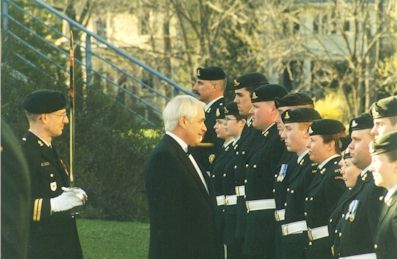
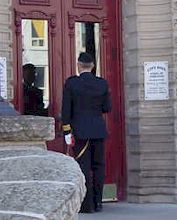
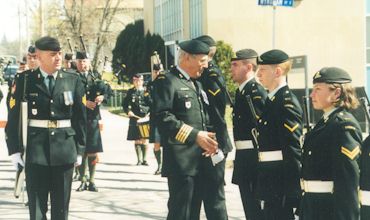
Culminating in the, aptly named, Castle Gala Ball, on Saturday, April 27, the Regiment was kept busy throughout the preceding week. The pomp began Tuesday the 23rd with a Guard of Honour for The Honourable James K. Bartleman, on the occasion of his first visit to the 'Royal City' since his recent installment as Ontario's Lieutenant Governor. The Guard of Honour was commanded by Captain Greg Frank, Battery Commander of 29th Field Battery, and was inspected at Guelph's River Run Centre (pictured right).
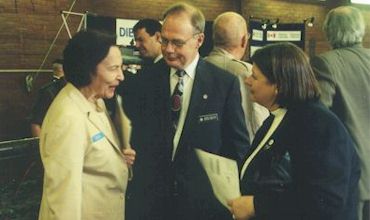
A meeting of the Canadian Forces Liaison Council (CFLC) was held at the Guelph Armoury on Friday the 26th and while not officially part of the 175th celebrations, the event showcased both the Regiment and the CFLC to local business leaders, invited to attend the reception and open house by their militia employees.
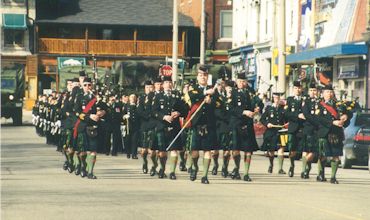
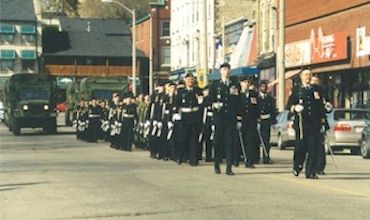
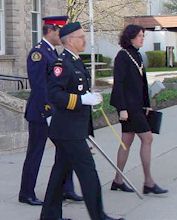
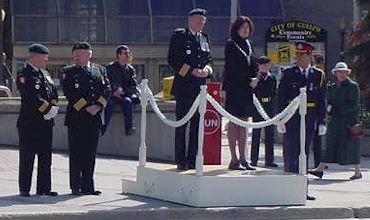
The big day finally arrived and began with suitable pomp as, with drums beating, bayonets fixed, and our colours on parade, the Regiment exercised its Freedom of the City. Close support of the musical kind was ably supplied by the Band of the Argyll and Sutherland Highlanders of Canada (Princess Louise's) as the Regiment, under the command of Lieutenant-Colonel Robert W. Elliott, CD marched through the streets to City Hall and then past the Guelph Cenotaph. While the Colonel Commandant of the Royal Regiment of Canadian Artillery, Major-General (Retired) J.A. MacInnis CMM, MSC, CD, and Her Worship Karen Farbridge, Mayor of Guelph, took the salute, for every gunner on parade the greatest honour came as onlookers broke into spontaneous applause as the Regiment marched back to the Armoury.
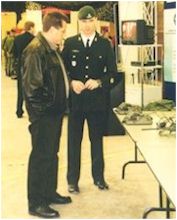
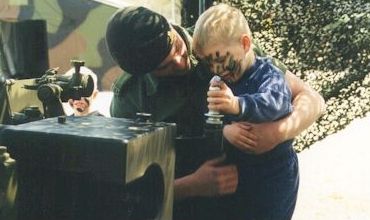
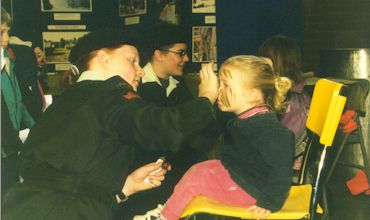
Dismissal from the parade then saw a frantic change of clothing as Gunners exchanged DEU's for combats as gears were immediately switched and the Regiment hosted an open house held in conjunction with the local architectural conservation councils "Doors Open" series of guided tours. In the four hours the Armoury was open to the public more than 500 people took part in the tours, or visited the many displays set up by the Regiment, and local defence companies such as GMA Cover Corp, Human Systems, Valcom and Diemaco.
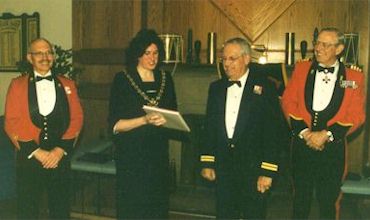
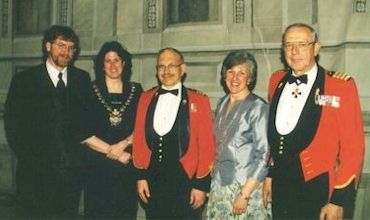
By early evening clothing was again being switched as mess kit was put on in anticipation of the evening's festivities, a formal ball hosted jointly by the Regiment and the City of Guelph. Guests were entertained with performance from the Dance Band of the 7th Toronto Regiment RCA, the Argyll and Sutherland Highlanders of Canada (Prince Louise's) Pipes and Drums, Highland Dancers from the Mary Ellen Cann School of Highland Dancing, Jazz Pianist John Zadro and DJ Brad Howell.
By the time the party was winding down the Regiment was finally able to look back on a busy, though rewarding week. Over 1000 citizens passed through the Armoury doors over the weekend, the greatest benefit of which was a renewed sense of community between the City of Guelph, and her own Guelph Gunners.
To Top
Feedom of the City Parade
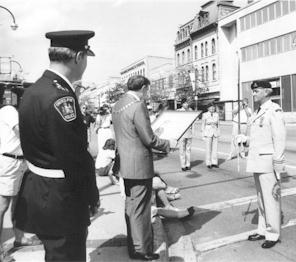
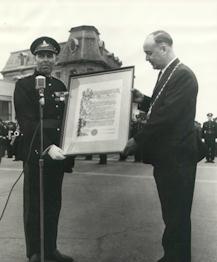
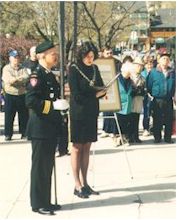
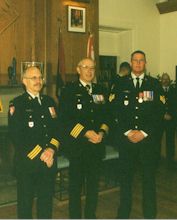
The original Freedom of the City Proclamation was presented to Lieutenant-Colonel D.G. Ingram by Guelph Mayor R. Smith 1 October 1966 (picture immediate right) as part of the Regiment's Centennial celebrations. The ceremony was re-enacted on the occasion of the Regiment's 125th Anniversary. Guelph Mayor J. Counsell presented Lieutenant-Colonel R.G. French the original proclamation under the watchful eye of Police Chief D. Stewart in the summer of 1991 (picture far right).
The Ceremony
The Freedom of the City Parade begins at 10 AM when the Regiment marches from the Armoury to City Hall with the Argyll and Sutherland Highlanders Regiment of Canada (Princess Louise's) Pipes and Drums leading. The Commanding Officer, Lieutenant-Colonel R.W. Elliott, CD will move to the doors of City Hall, where he will knock 3 times with the pommel of his sword. Police Chief Rob Davis will open the doors and request Lieutenant-Colonel Elliott to identify his unit and state it's purpose. If satisfied with the Commanding Officer's response, Chief Davis will allow Lieutenant-Colonel Elliott to meet with Mayor Farbridge. The Commanding Officer will invite Mayor Farbridge to present the original Proclamation of the Freedom of the City to the Regiment. All 3 participants move to a position in front of the Regiment where the Mayor will read aloud the Proclamation of the Freedom of the City. The Commanding Officer accepts the proclamation and returns to the Regiment. The Regiment then "fixes bayonets", uncases their colours - or, in the case of the Artillery, uncovers their guns which act as their colours - and marches north on Wyndham Street with the Mayor taking the salute at St. George's Square. The Regiment will march past the Cenotaph and south on Wyndham Street back to the Armoury.
The Tradition
One of the most prized honours of a military unit - usually from the army - is the granting of Freedom of the City, a tradition dating from the 1500's. Most people are familiar with the colour and pageantry of a regular military parade, so what's the importance about granting of this privilege? Awarding the Freedom of the City means, in the physical sense, the granting of the privilege to march through the city with "drums beating, colours flying and bayonets fixed." In the moral sense, it is much more.
In centuries past, many cities were independent states, surrounded by walls and governing their own affairs. When they required defence, it was common to hire mercenary armies instead of risking their own citizens.
Mercenaries would fight for whomever paid them, and it was not uncommon to have them change sides on the promise of more pay. It was also not unheard of for these mercenary soldiers to augment their pay by pillaging the cities they were hired to defend. Therefore, before these private armies were actually allowed into the city they were defending, they had to prove their trust-worthiness - usually by winning a battle and not turning on their benefactors. The reward for faithfulness and trustworthiness was called the "Freedom of the City".
The granting of this Freedom is a private matter between civic officials and the unit, and the decision to grant this symbolic freedom rests with the municipal authorities. It is usually granted to a unit that has enjoyed a long and happy relationship with a city or to mark peoples' gratitude for heroic service.
To Top
Regimental History
Canada's 'big guns' have long come from Guelph
Friday November 2, 2001
Gregory Oakes
Guelph Mercury
Artillery began as that very ancient and basic habit of one angry man throwing things at another man and grew into a science. In Wellington, the 11th Field Artillery Regiment evolved out of the traditional county militia structure. In 1857, all the units in Wellington County were put on a voluntary basis and reorganized under the auspices of the 1st Wellington Battalion.
When Canada feared invasion in 1866 by the Fenian Brotherhood, a group of Irish rebels intent on attacking Canada to avenge the English occupation of Ireland, an artillery militia unit was formed, equipped with a nine pound cannon.
On July 20, 1866, an artillery unit named the Guelph Garrison Battery was organized as No. 1 Company of the 30th Wellington Battalion of Rifles. On Aug. 7, 1866, the battery, commanded by Capt. Barclay, met for its first drill period under the direction of Lieut. Armstrong of the Wellington Rifles.
Five years later, the battery was detached from its parent unit and renamed the Wellington Field Battery of Artillery. In 1871, Captain A.H. MacDonald took over command of the battery. Eventually, authority was granted to enrol a second section made of students from the Ontario Agricultural College at Guelph. On March 22, 1878, this group became the Ontario Field Battery.
The long and valuable association of the college with the militia is commemorated by the aged garrison gun placed outside of the student centre at the University of Guelph. This sad and neglected relic is constantly abused by vandalism.
The two batteries were combined to create the 1st Provisional Brigade of Field Artillery on March 24, 1880. The Wellington unit became No. 1 Field Battery and the O.A.C. unit became No. 2 Field Battery. This heralded the formation of Canada's oldest continuous artillery regiment. In 1887, the batteries were renumbered No. 11 and No. 16.
When the regiment was created in 1880, Major A.H. MacDonald, who was later mayor of Guelph, was commanding officer. Capt. W. Nicholl commanded the Wellington Battery and Capt. David McCrae, father of John McCrae, author of In Flanders Fields, commanded the Ontario Battery. The surgeon was Henry Howitt and the veterinary officer was E.A.A. Grange, later principal of the Ontario Veterinary College.
A photograph of the senior officers of the 1st Provisional Brigade of Artillery taken in 1880 shows the Regiment's first commanding officer LCol MacDonald (#3), and Capt David McCrea (#6).![The senior officers of the 1st Provisional Brigade of Artillery. Taken in 1880, the year the brigade (as the Regiment was then called) was raised, the photo shows the Regiment's first commanding officer LCol MacDonald (#3), and Capt David McCrea (#6), father of LCol John McCrea[11th Field Regt]](/opint/images/11fd0001.jpg)
The local artillery maintained a high state of efficiency throughout the twilight years of the 19th century and constantly won the major prizes during peacetime training in the Victorian era. Today, the Officer's Mess at the Guelph Armoury boasts a collection of silver trophies that attests to the prowess of the 11th Field.
With the outbreak of the Boer War, none of the Wellington units was mobilized. A separate military unit was formed as the government bowed to public opinion. Lieut. John McCrae, of the 16th Battery, commanded a section of D Battery, Wellington County's contribution to the force that left for South Africa on Jan. 4, 1900. The battery fought in 32 actions including the rearguard action action at Leliefontein, where three Victoria Crosses were won in D Battery.
In 1911, Canada reorganized its militia in response to overseas tensions. It sought to create more cavalry and artillery units. Guelph had the only artillery equipment regiment at that time although this unit was utilizing antiquated five-inch howitzers. The brigade was renamed the 1st (Howitzer) Brigade Canadian Forces Artillery in 1913. When war broke out in 1914, new mobilization plans were devised and names were changed again.
During the First World War, five artillery batteries were raised in Guelph. The 16th Battery was mobilized under Major W. Simpson with its militia personnel intact. It proceeded to England on May 20, 1915, where it formed part of the 2nd Canadian Divisional Artillery.
New formations were created and many existing Canadian artillery batteries such as the 11th Battery of Guelph sat idle or were disbanded. The 29th Battery was mobilized in Guelph under Major F. Coghlan, a Guelph dentist, in 1915. Virtually all of its trained members came from the 11th Battery. That same year the 43rd Battery mobilized in Guelph under the command of Major the Honourary Lieut.-Col. David McCrae. On Feb. 26, 1916, both batteries embarked overseas to form the 11th (Howitzer) Brigade CFA.
The 55th and 56th Batteries were recruited in Guelph in 1916, the latter consisting of many college staff and students. Later the 63rd and 64th Batteries were created in Guelph. The gas attack at Ypres, the battles of the Somme, Passchendaele, Amiens Arras, and Cambria and Mons mark the road trodden by these gunners, but in no battle did they stand more gloriously than at Vimy Ridge, where such great sacrifice reaped so little reward. The brigade fought at all the major battles during the static trench warfare of France.
After the war, the Guelph group was redesignated the 11th Brigade. In another numbers game, the 19th Battery absorbed the 11th Battery and 16th Battery, 43rd Battery and 63rd Battery formed the balance of the brigade. The latter batteries, 43 and 63, eventually became paper tigers with declining enrolment. In 1925, the brigade was renamed the 11th Field Brigade Canadian Artillery.
In 1925, Lieut.-Col. George Drew took command of the regiment. He had enlisted in 1910 and fought overseas. He rose to be mayor of Guelph, premier of Ontario, federal leader of the opposition for the conservatives, and Canada's High Commissioner to the United Kingdom.
The Wellington Rifles were converted to artillery in 1936, a year before their centennial anniversary, to augment the 63rd Battery. Artillery became and continues to be the predominant militia force of this county.
During the Second World War, the 29th Battery was the first to mobilize. It went overseas in 1939 as part of the 3rd Field Brigade, which became the 11th Brigade Royal Canadian Artillery (RCA). In 1942, the 11th Brigade was renamed the 11th Field Regiment RCA. They fought in Sicily and Italy, claiming to be part of the first Canadian unit from Italy to reach German soil on March 31, 1945. Later, they fought in Holland and Germany.
The 16th and 43rd Batteries were mobilized in 1940 and formed the 12th Field Regiment RCA. As part of the 3rd Canadian Division, they took part in the D-Day landings and fought through northern Europe in all major Canadian engagements.
The 63rd Battery was mobilized in 1942 and became an anti-aircraft battery as part of the 19th Field Regiment RCA. After the war in 1946, the 11th Field Regiment RCA continued with 29, 16, and 43 Batteries.
The militia was mobilized for the Korean War in 1951 but a battery was mobilized and designated the 216th Battery.
After the war until 1965, the 16th Battery was stationed in Fergus. In 1960 the Regiment was officially designated as the 11th Field Artillery Regiment.
The regiment celebrated its Centennial in 1966 with a vice-regal visit to Guelph from Governor-General and Mme. Vanier, and a jet fly-past by the Royal Canadian Air Force in T-33 aircraft. The regiment was given the freedom of the city, and the Fenian Brotherhood of Buffalo, New York, attended to apologized for the Fenian Raids of 1866.
Constant downsizing throughout peacetime resulted in the 1970 amalgamation of the 11th Field with the 8th Field of Hamilton. Today the 11th Field Royal Canadian Artillery Regiment consists of 11, 29, and 16 Batteries. The latter two perpetuate the local units while the 11th Battery represents what is left of the Hamilton and Wentworth units.
Guelph is known in the military as "Gunner Town" due to its long history as a centre for the artillery and its contribution of outstanding personnel to the corps. The 11th Field Artillery Regiment is justly proud of its splendid record.
This article was edited for this special edition. The original can be read in Historic Guelph, The Royal City, Vol. XXXV 1996, published September 1996 by the Guelph Historical Society.
To Top





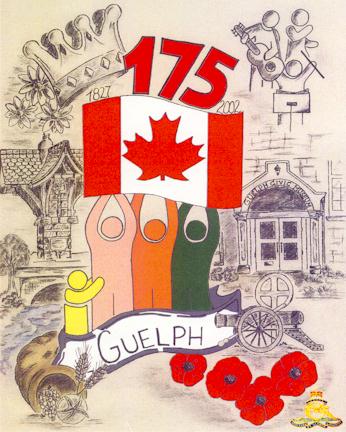 Kitchener artist would do well in a Guelph trivia contest